Active@ UNDELETE Ver 2.0
See documentation for latest version
Microsoft® Distributed COM (DCOM) extends the Component Object Model (COM) to support communication among objects on different computers-on a LAN, a WAN, or even the Internet. With DCOM, your application can be distributed at locations that make the most sense to your customer and to the application.
Because DCOM is a seamless evolution of COM, the world's leading component technology, you can take advantage of your existing investment in COM-based applications, components, tools, and knowledge to move into the world of standards-based distributed computing. As you do so, DCOM handles low-level details of network protocols so you can focus on your real business: providing great solutions to your customers.
DCOM is an extension of the Component Object Model (COM). COM defines how components and their clients interact. This interaction is defined such that the client and the component can connect without the need of any intermediary system component. The client calls methods in the component without any overhead whatsoever. Figure 1 illustrates this in the notation of the Component Object Model:

In today's operating systems, processes are shielded from each other. A client that needs to communicate with a component in another process cannot call the component directly, but has to use some form of interprocess communication provided by the operating system. COM provides this communication in a completely transparent fashion: it intercepts calls from the client and forwards them to the component in another process. Figure 2 illustrates how the COM/DCOM run-time libraries provide the link between client and component.
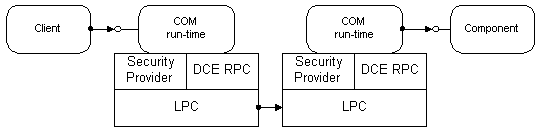
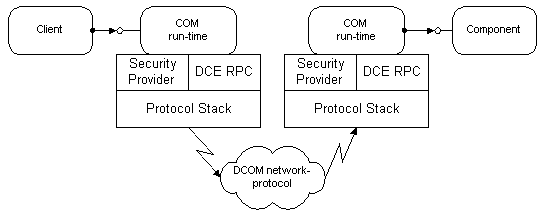
When client and component reside on different machines, DCOM simply replaces the local interprocess communication with a network protocol. Neither the client nor the component is aware that the wire that connects them has just become a little longer.
Figure 3 shows the overall DCOM architecture: The COM run-time provides object-oriented services to clients and components and uses RPC and the security provider to generate standard network packets that conform to the DCOM wire-protocol standard.
DCOM makes it easy to write a distributed application that
DCOM is the TCP/IP of objects.

